Freelance Jewelry CAD Designer vs. a Professional CAD Studio: Which Should You Hire?
Choosing between a freelance jewelry CAD designer and a professional CAD studio depends on your budget, design complexity, turnaround time, and production needs. Explore the key differences in expertise, scalability, revisions, and support to find the right partner for your jewelry brand.
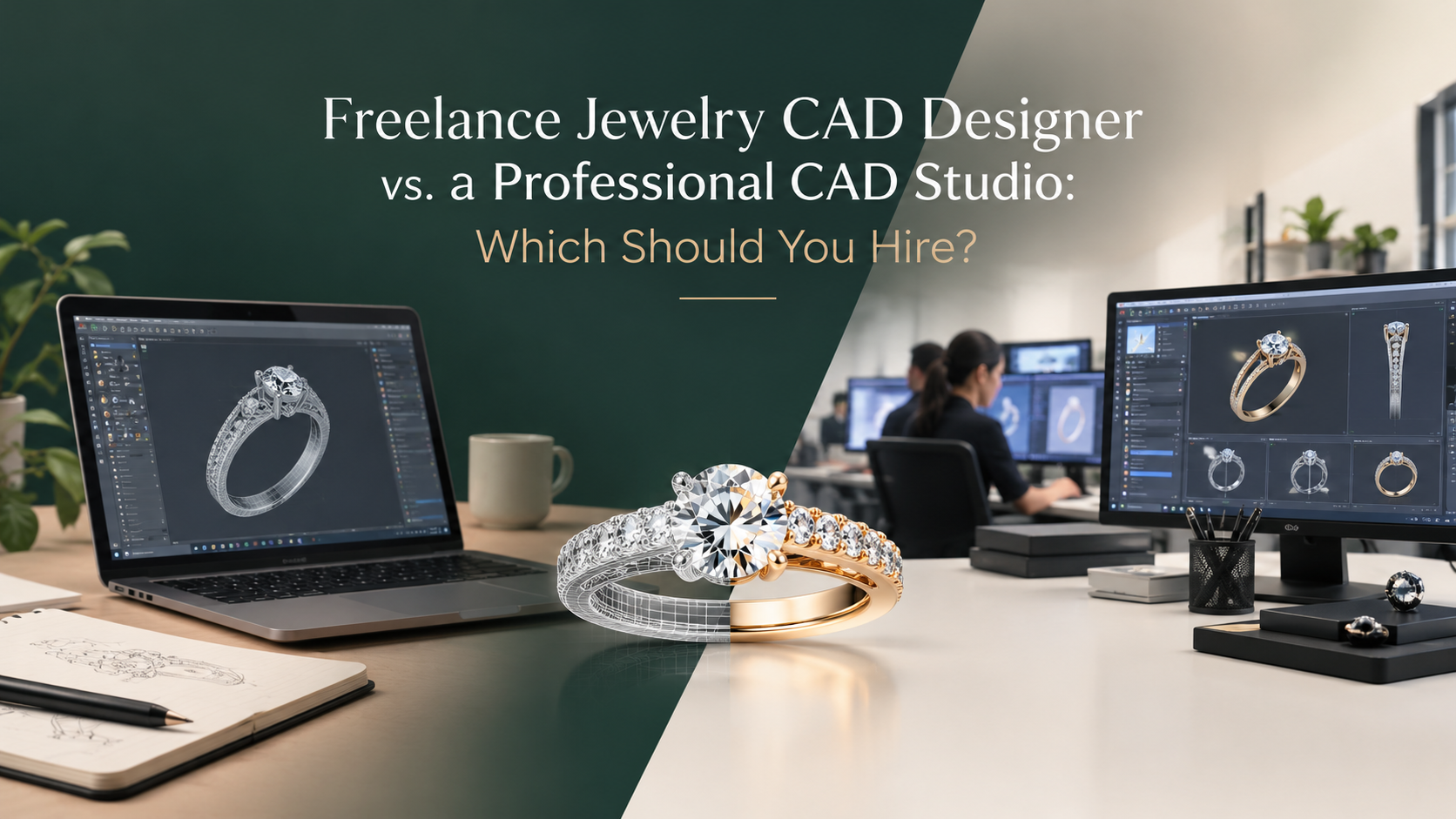
A freelance jewelry CAD designer is the right hire for one defined piece that you can supervise yourself. A studio is the right hire when the work is a catalog, a deadline, or a file that has to survive a caster and a contract. The hourly rate favors the freelancer. Almost everything around the rate, from backup to revision rules to who owns the file, favors the studio.
That is the whole conclusion, and the rest of this post is the reasoning. One disclosure first: we are a rendering studio that also models for a fee, so we sell the studio side of this choice. That is why the freelancer gets real wins below.
What A Freelance Jewelry CAD Designer Costs, And What A Studio Quotes
Freelancers usually price by the hour, and studios usually price by the design. That difference matters more than either number.
Upwork's own rate guide puts independent jewelry designers at $15 to $43 an hour. An eight-hour day at those rates is $120 to $344. The figure covers jewelry designers as a whole, so a specialist in production-ready CAD may sit above it.
Neither number is the price of your ring. A rate tells you what an hour costs. It does not tell you how many hours a ring takes, and a freelancer cannot give you that until the brief is fixed. For a published per-design figure, one custom-jewelry price list (last updated October 2024) shows a CAD drawing of a simple design at $500. That is a retail fee, not a freelancer's or a studio's, but per-design prices are rarely published at all.
|
Model |
How it is charged |
What pushes the total up |
Main risk |
|---|---|---|---|
|
Freelancer, hourly |
Rate times hours worked |
Revisions, rework, slow files |
An open-ended total |
|
Freelancer, fixed fee |
One price per design |
Scope changes get renegotiated |
Disputes over what a revision is |
|
Studio, per design |
Quote after the brief, approved first |
Stone count, complexity |
Less room to change course mid-job |
|
Studio, volume |
A price across a set of designs |
Number of designs, shared parts |
Committing to a batch |
Whatever the model, the same few things move the hours, and you can use them to sanity-check any estimate:
- Stone count. Every stone needs a seat, and a pave field needs hundreds of them placed by hand.
- Texture. Hand engraving and hammered finishes can be modeled, but matching their character takes time that a bench gets for free.
- Reference quality. A dimensioned drawing models quickly. A phone photo of a ring someone else made does not.
- Constraints from the caster. Minimum wall thickness and stone tolerances are cheap to design in and expensive to retrofit.
Compare cost per approved piece, not cost per hour. Add the hours spent re-explaining the brief, the revision rounds, and any repair when a caster rejects the file. A freelancer at $20 an hour who needs 10 hours of rework has cost more than a fixed fee with two counted rounds. Ask every candidate for an hours estimate in writing before work starts.
We do not publish a modeling price, because modeling is a separate fee quoted per design when a client has no CAD file. What we can state is the order of events: you get the quote, nothing is charged before you approve it, and an NDA is signed before any file is opened.
What Happens When Your Freelancer Goes Quiet
A freelance jewelry CAD designer is one person, so every risk to the project is a risk to that person. Illness, a family emergency, a larger client, or a week offline all stop your work, and nobody else can pick it up. That is not a character flaw. It is how one-person capacity works.
Capacity is the other half. One designer models one piece at a time. If you need 12 pieces before a trade show, a freelancer will decline, take them in sequence, or subcontract without telling you. The last case deserves a direct question, because it changes who holds your files and who owns the output.
A studio spreads the same work across a team, so one absence slows a job and does not stop it. A second modeler can open the file and carry on. A studio also has a plain commercial reason to keep you: a lapsed account is lost revenue. That is incentive rather than virtue, but it works in your favor.
Ask any candidate three questions:
- Who takes over if you are out for a week?
- Where is the working file kept?
- How many pieces can you hold in the queue at once?
You can also protect yourself on either side by paying in milestones and taking the working file at each one. A freelancer who disappears midway takes an unfinished model with them if you only receive files at the end. If you hold the file from the block-in stage onward, the worst case is hiring someone to finish it. Ask for the file at the end of each stage, and release payment against it.
A freelancer with a clear answer to all three questions is a better bet than a studio with none. Studios have their own version of this failure. A small studio's queue fills, and a junior modeler can end up with your piece while a senior one sells the work. Ask who will actually build it, and ask to see their work on a piece like yours.
Who Checks The File Before It Reaches You
A freelance CAD jewelry designer's quality control is the designer. They model the piece, judge the piece, and approve it. Many do this well, and a designer with years at a bench has seen what fails in casting. But no second person has looked at the file, so a slip the designer cannot see stays in it until the caster finds it.
The control that matters is review by a person who did not build the file. In our render work, every image is reviewed by someone with jewelry bench experience before delivery. Ask any studio, and any freelancer, whether the equivalent exists for modeling files.
A reviewer should catch the problems that look fine on screen and fail in metal:
- Stone seats that do not match the stone size on the brief
- Prongs too thin to survive polishing, or too heavy to grip the stone
- Walls thin enough to fail in casting
- A shank that does not match the ring size you asked for
- Geometry that closes on screen but breaks when printed
Stage reviews are the second. Whoever you hire, ask for a view of the model at three points: a rough block-in of the overall form, a detailed model with stone seats and prongs, and the final file. The block-in is where you correct proportions, when a change costs minutes. If a designer wants to show you only the finished model, the cheapest correction window has already closed.
Revision rules are the third. Agree in writing what a revision is. A revision changes something inside the approved brief, such as band width or stone height. A new design is a different brief. Without that line, hourly billing turns every change into a negotiation, and fixed fees turn it into a dispute.
The reason to settle this early is that changes get more expensive the later they arrive. The same price list notes that design changes are not allowed at the wax model stage, because a change means restarting the work. A change in the file costs minutes. A change in wax or metal costs the piece.
Our own render orders include two revision rounds at every price, and revisions ship within 24 hours of your notes. Those terms cover renders, not modeling, and a modeling quote states its own. The principle carries over either way: count the rounds before the work starts, and approve the model on screen before anything is printed or cast.
File Handoff And Ownership: What To Get In Writing
Ask for three things at handoff: the native file, a neutral export, and the written terms.
The native file is the 3DM or the program's own format, with its structure intact so someone else can edit it later. A neutral export such as STEP or STL is what a manufacturer or printer usually takes. An STL alone is a mesh, a fixed set of triangles, and it does not edit or render as cleanly as the surfaces it came from (why a mesh export changes the render). A designer who will only send an STL has sold you a picture of the design rather than the design.
The file should also carry what the next person needs: stone sizes and counts, the intended metal, the ring size, and any tolerance the caster asked for. A freelancer sends this if you ask for it. A studio should send it on every job, because the second modeler who opens the file has nothing else to go on. For what a finished file does and does not hold, see what a 3D jewelry model actually holds.
The brief you hand over decides how much of this works, and a design lead can write a good one in an hour. Include:
- Dimensioned drawings or clear reference images, front, side, and top
- Stone type, shape, size, and count, with the setting style for each
- Metal and target weight, if weight is a cost limit
- Ring size or finished dimensions
- Which manufacturer or caster will receive the file, and any limits they set
- A deadline, and the date you need the file rather than the date you hope for
If you have only a hand sketch or a photo, say so. A model has to be built from it first, and that is a separate step with its own fee, quoted before it starts.
Communication differs in a plain way. With a freelancer you have one inbox and one time zone, and replies arrive when that person is working. With a studio you usually have a project contact who stays constant while the modelers change. Neither is better as a rule. If you design every piece alongside one person, that person's understanding of your taste is worth more than any process.
Ownership is where hires go wrong, and payment does not settle it. Under US copyright law the creator owns a work unless the statute says otherwise. A commissioned work counts as work made for hire only if it falls in one of nine listed categories and both sides sign a written agreement saying so. The categories in 17 U.S.C. section 101 include contributions to collective works, parts of audiovisual works, and translations. A jewelry 3D model is not on the list. So paying for a model does not by itself hand you the copyright, and you need a written assignment that says you own the file and the design. Other countries have their own rules, so confirm yours. This is a reason to ask a lawyer, not legal advice.
A freelancer should sign an assignment and an NDA if you ask, and some will offer both first. With a studio, check the chain. Find out whether the modelers are employees or subcontractors, and whether the studio's contract with them passes the rights on to you. In our case, an NDA is signed before any file is opened, the client keeps ownership of the design, and white-label delivery is available.
When A Freelancer Is The Better Hire
Hire the freelancer when the work is one piece, the brief is clear, and you can judge the output yourself. A single custom ring for a known client, a pendant redesign, a one-off commission. In those cases a studio's team, process, and backup are overhead you pay for and never use.
Three more cases favor the individual:
- A style you cannot describe. If you want a designer who brings taste, sketches beside you, and pushes back, you are hiring a person. One person with a point of view beats a team following a brief.
- A designer you can meet. Someone local can sit with you at the bench, look at a wax, and hand you a printed resin test. A search for a jewelry CAD designer near me is a sound instinct for exactly this reason, and it is the one case where location earns its place.
- A small, clear job on a tight budget. An hourly rate on a short brief is hard to beat, because the hours are few enough to estimate honestly.
A freelancer only works for you if you vet one properly. Ask for a reference from a caster or manufacturer, not from another designer, because the caster is the person who has opened their files. Ask what program they model in, and whether they can export a native file you can open. And ask how they handle a file that comes back from the caster with a problem. The answer tells you whether they treat a rejected file as their job to fix or as your job to pay for twice.
Here is where we lose. We are a rendering studio, and modeling sits beside the service rather than at its center. If what you need is a designer to develop a collection with you from sketches, a specialist modeler with a bench background is a better fit than we are. If you are still deciding whether you need modeling at all, CAD modeling and rendering are two separate purchases, and many buyers only need one.
Why Catalog And Wholesale CAD Work Favors A Studio
Volume turns the comparison around. One freelancer is cheapest for one piece. At 30 pieces, the cost that grows is inconsistency.
A buyer reading a line sheet notices when ring 14 has different prongs from ring 3. A wholesale line has to look like it came from one hand, and that takes decisions made once and applied everywhere:
- Shared geometry. Parts that repeat across a line, such as a head, a gallery, or a shank profile, should be built once and reused.
- Parallel work. Two or more modelers can work one line at the same time, where a single freelancer works through it in order.
- One standard for files. Naming, layer structure, and stone-seat style stay the same from the first piece to the last.
- Continuity. A line is never finished. Next season someone changes a stone size or adds a metal, and the person who opens the file has to find it, understand it, and edit it. A studio should keep files in one place under a naming scheme that outlasts any one modeler. A freelancer often keeps them on a personal drive, and the project depends on that drive surviving.
Stone count drives time on both sides of the work. A solitaire is simple, and a 240-stone pave cuff is not. For renders, heavy pave typically adds 20 to 40 percent, and modeling that many stone seats carries a cost of its own.
Once the models exist, rendering the line is a separate and much smaller purchase. Jewelry catalog rendering is priced at a flat $15 per CAD file, which buys 9 HD images and 3 videos in rose, white, and yellow gold.
A studio is not automatically consistent, so test the claim. Ask to see three pieces from one client's line side by side, and look at the prongs, the shanks, and the stone seats.
Searching For A Jewelry CAD Designer Freelance, Online, Or Free
Searches for a jewelry CAD designer freelance, online, or free mostly land on the same marketplaces. Listings there share one feature: the price shown is a starting point. Read the portfolio before the rate.
A portfolio worth trusting shows the same piece as a CAD view and as cast metal. It includes at least one file sent to a caster, and ideally a note from the caster on how it came back. A portfolio of renders alone proves rendering skill, which is a different skill from modeling a ring that casts cleanly.
Online is not a handicap. The work happens on a screen, and files travel. What needs physical presence is the bench: casting, setting, and fit. Choose your caster's location with care, and treat your designer's location as a convenience.
"Free" deserves care. Free software exists, and the CAD software post covers why the free tiers often exclude a jewelry business. When someone offers a CAD design for free, ask what they take in return, whether that is the rights, a casting commitment, or a fee credited later. The one free thing we offer is a sample render of a CAD file you already have: one file, full quality, no payment details asked, once per prospect.
How To Test Either Option With One Paid Piece
Send the same brief to one freelance jewelry CAD designer and one studio, and pay both for a single simple piece. Judge them on results, in this order:
- Did the estimate match the invoice?
- Did the file open cleanly in your caster's software?
- Were the stone seats and prongs right without you pointing them out?
- Did the revisions follow the rules you set?
- Did you receive a signed assignment and an NDA?
Then choose on evidence. If both pass, pick the one you can picture working with at piece 30 rather than piece one.
When you have a model you trust, any studio confident in its work will render one piece to prove it. We will render a CAD file of yours before you pay for anything, so send us a file and judge the result against whoever modeled it.
Curious how this works in practice? See the process, browse the portfolio, check pricing, or see all jewelry rendering services.