NURBS
Also called non-uniform rational b-spline, nurbs surface
NURBS is a way of defining curves and surfaces in CAD using mathematical control points rather than flat faces. The result stays perfectly smooth at any scale, which is why it is the standard for ring shanks, bands, and other clean curved jewelry forms.
How NURBS surfaces behave
A NURBS curve is described by control points and a formula, not by a chain of segments. Move a control point and the whole curve flows to follow it. Zoom in as far as you like and the curve is still a curve.
Rhino, MatrixGold, and RhinoGold all work this way, which is why 3DM files hold NURBS surfaces. Meshes are only created when you export to STL or OBJ, or when a renderer prepares the model.
What it means for your renders
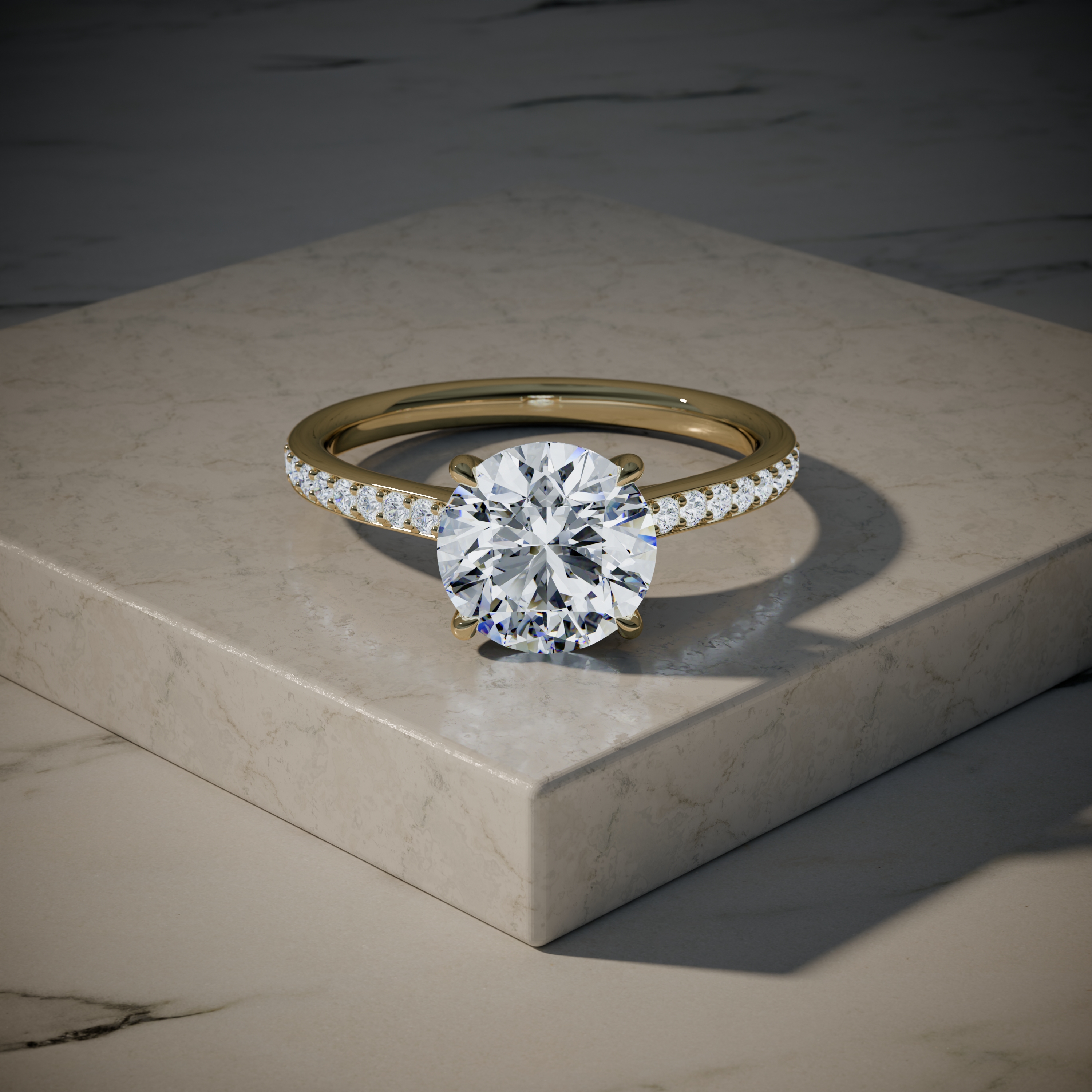
NURBS geometry gives the cleanest render of polished metal, because there is no baked-in facet count to give the surface away. We choose the mesh quality at render time and can push it as fine as a close-up crop needs.
It also makes edits cheap. A shank that needs to be half a millimetre thinner is a surface adjustment, not a remesh. That matters during the two revision rounds included with every file.
For sculpted, organic, or heavily textured pieces, mesh modelling in something like ZBrush is often the better tool. Both render fine, they just come with different tradeoffs.
Questions about NURBS
Is NURBS better than mesh for jewelry?
For clean geometric work such as bands, shanks, and settings, yes. NURBS stays exactly smooth and edits easily. For organic sculpted detail, mesh modelling is usually easier.
Do you need NURBS files to render?
No. We render from 3DM, STL, OBJ, and STEP, and only 3DM and STEP carry exact geometry. Meshes render well too, they just need to be exported at a fine setting.